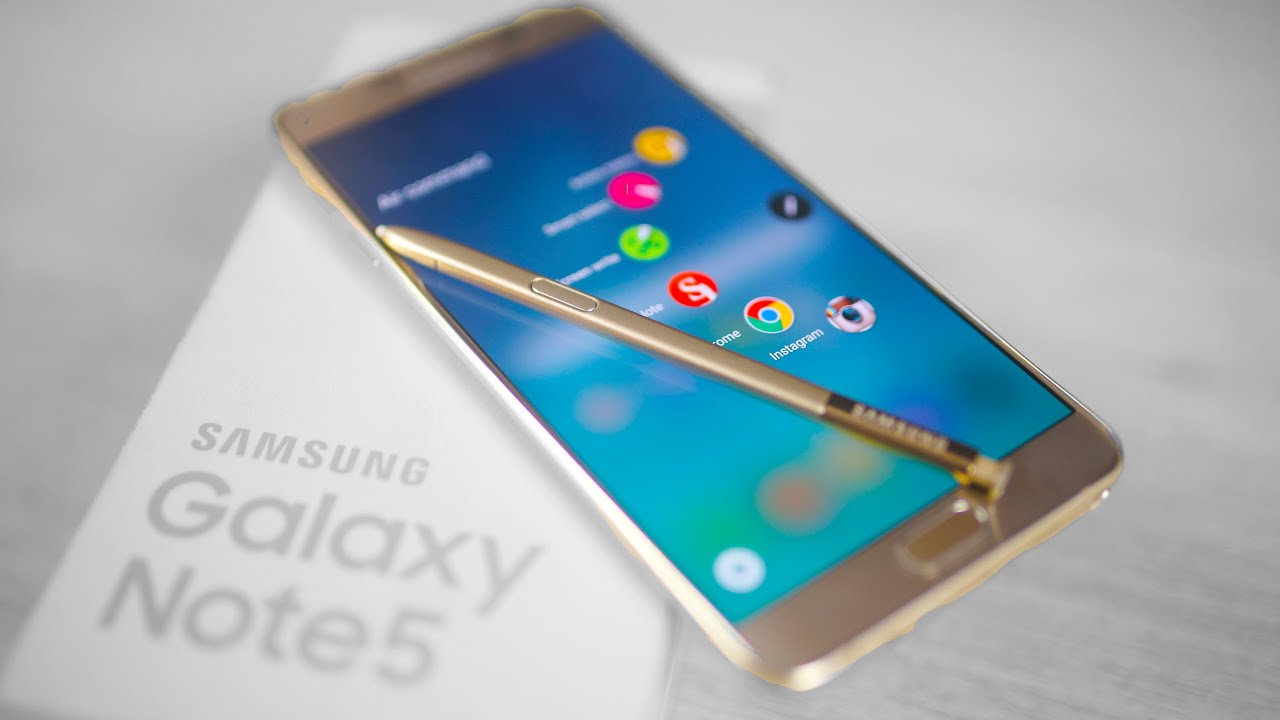
For a while there, companies like Palm and Microsoft insisted that the mark of a really serious smartphone was the ability to write on it with a stylus. The market seemingly changed its mind with the advent of capacitive touchscreens, and the stylus became something to scoff at, a holdover from antiquated operating systems like Windows Mobile and Palm OS. But then there is Samsung, which has been attempting for years now to preserve the notion with numerous versions of the Galaxy Note, a phablet that in no way felt or looked as nice as it could be. Thankfully, these days are over. The new Galaxy Note 5 is the finest phablet phone Samsung has produced however, and it just may make a believer out of a couple of naysayers.
Pros
- Amazing screen
- Top-tier performance
- Much-improved S Pen experience
- Awesome camera
Cons
- Grabbing the S Pen takes an extra step
- Some will miss the microSD slot
- Far pricier than similar phones
Summary
Samsung's Galaxy Note series has in no way been for everyone, but the Note 5 just might change some minds. It's the smallest, most comfy version of the phablet to date, and thoughtful computer software tweaks make the S Pen feel way less gimmicky. A fantastic screen and top quality functionality are icing on the proverbial cake, but some persons will nevertheless feel burned by the lack of expandable memory, a larger 128GB option or a removable battery.
Hardware
Let's cut to the chase: This is the most attractive, most comfortable-feeling Galaxy Note that Samsung has ever been created. Thinking about what the company's churned out in the past, this probably isn't a shock to hear. The Gorilla Glass-and-metal design language carried over from the Galaxy S6 line suggests the Galaxy Note ultimately has the premium feel it often deserved (and without having any tacky faux-leather, either).


The generous curve of the backplate and the trimmed-down bezels surrounding the 5.7-inch, Quad HD, Super AMOLED screen make the Note 5 substantially less difficult to hold than any of the prior-gen Notes, a really serious feat when you contemplate how beastly that screen essentially is. Of course, not everyone's a fan of glass-clad phones a banged-up metal or plastic cover does not appear as bad as a pane of shattered glass. Following a week and a half of throwing the device in and out of a bag, though, the glass on the unit still appears immaculate. As for the front? Not so much. There are currently a couple of indelible nicks on the screen and on the fingerprint sensor/home button. Fortunately, the button continues to work, even if it does appear a little worse for wear.
And of course, there's the S Pen. I will revisit this in a moment, but suffice to say, it really is leaner and lighter this year, and now has a clicky finish you'll use to unlock it from the garage located on the Note's bottom edge. There is lots of excitement to be had obnoxiously clicking it like your old ballpoints, but otherwise, it adds a superfluous step when you want to whip the Pen out, which sucks if you want to jot one thing down in a jiffy.
Under the hood, we again have one of Samsung's own octa-core Exynos 7420 chipsets, with 4 cores clocked at 2.1GHz and yet another four thrumming away at 1.5GHz. Pair that with 4GB of RAM and you have got the makings of a virtual powerhouse. If all this sounds familiar (you have been paying attention), that's because it is: These are the exact same components in the Galaxy S6 Edge+, which amounted to a fairly modest upgrade over what we got in the original S6 series. Seriously, the greatest change here is the additional RAM the Galaxy S6 had 3 gigs, not four.

For some of you, though, another change may possibly make all the difference. It really is no secret that Samsung has it out for microSD, but things are made more complicated by the Note 5's lack of more spacious storage options. You can plunk down cash for a 32GB or 64GB version, but the 128GB model Samsung initially hinted at is not coming any time soon. Cloud storage is beneficial, and convenient, and I still wouldn't attempt to squeeze my entire mobile life into a device with only 32GB of space. Oh, and the Note 5's design also means you can not touch the 3,000mAh battery inside, a blow to power customers who enjoyed the capability to swap out the cells on the Note 4 and Note Edge. Look on the bright side. You'll be upgrading again in a couple years anyway.
Display and sound
If there's one factor Samsung definitely gets, it's how to make a seriously excellent-looking screen. The Note 5's QHD, Super AMOLED display isn't a big leap over the Note 4's screen (which was the very same size and ran at the same resolution), but there is enough of a enhance in saturation and general brightness to make the sequel a clear winner.

Colors are vivid and vibrant in that commonly AMOLED-y way, so even though these oversaturated colors aren't normally precise, per se, they're still a treat to look at. Whites are appropriately crisp (if a touch on the warm side) blacks are deep and you can easily view the screen even from off-kilter angles. Much more importantly, the screen is an absolute champ below the sweltering summer time sun. With brightness cranked up all the way, There is no trouble thumbing through some Haruki Murakami quick stories and numerous photo sets on Flickr. Peer closely enough at the screen in direct sunlight and you may well notice it sort of... pulsate (particularly when you are looking at apps or web-sites with a white background), but it is well worth the ability to basically use the phone outdoors. Some will argue that Quad HD displays aren't needed, and indeed, your eyes never stand a chance of selecting out the 518 pixels packed into any offered linear inch. Nonetheless, it's difficult to argue with the results here. Very well done, Sammy!

Too bad, then, that the screen is paired with a wimpy single speaker on the phone's bottom edge. Crank it all the way up and your tunes will play forcefully enough, but with a hollow, unsatisfying sound there is a distinct lack of oomph right here that is sadly, fairly prevalent in higher-end phones. In any case, you'd do better to save the speaker for the occasional internet video. Samsung hasn't totally neglected the audio, although: It built in assistance for 24-bit audio and a way to "upscale" your low-res MP3s and restore detail that was lost in the compression approach. I'm no acoustician and my ears have been broken from years of blasting dubstep, but the audio software program here doesn't appear to make any discernible difference. Perhaps I just have bad taste? Or maybe some of my songs just cannot be saved. Either way, save your expectations and you are going to be fine.
Apps
If you have fiddled with a Galaxy S6, you know exactly what to anticipate right here. The Note 5 comes with a TouchWiz-ified version of Android 5.1.1, and once more, I appreciate the lighter touch Samsung has been taking with its software. It really is not my preferred skin and I nevertheless think it pales in comparison to the stock Google Now Launcher, but I am pleasantly surprised by how a less obnoxious TouchWiz is these days.
All of Samsung's mainstay options are right here, and they all work as effectively as you'd anticipate them to. The Note 5's substantial screen makes a handful of of them really feel a lot more organic you can see a lot more of the two apps you have running in Multi Window mode, and the Flipboard Briefing window to the left of the house screen is a lot more spacious and satisfying when stretched out on a larger screen. In the previous version, all that additional real estate meant earlier Notes had gigantic app icons, but right here they are noticeably smaller (and slightly rounder). That will take a bit of getting used to to find them. I am glad, though, that Samsung finally figured out that individuals want space to spread out their stuff, instead of just keeping all the things scaled up to fill the bigger screen.

The evaluation unit came with 32GB of built-in storage, about 24GB of which is out there to users out of the box. Aside from Samsung's usual add-ons like S Health and S Voice (which performs terrific, but nonetheless went largely unused), apps like Instagram, Facebook and OneDrive come preloaded, but can be uninstalled. Not too bad, eh? Then again, my tester telephone is also an unlocked international model that is entirely free of carrier bloat.
Using the S Pen
Right, now we're getting down to brass tacks. Most of the Note 5's computer software alterations attempt to make the S Pen more functional, and basically Samsung did a fine job of getting it to feel less like a gimmick and far more like a tool. First points first: that cool clicky pen. I've generally hated how the S Pen is stuck in the Note 5's bottom. Removing it felt so unlike a normal pad and paper. The cool clicky thingy can be distracting though. Sure, it's fun to play with, but it really just further step that was added purely for style points.
What occurs after you pull the pen out depends on what the display's carrying out. If it is on, the screen blurs and the Air Command menu floats into view. From there, you can jot down Action Memos (think of them as speedy Post-it notes) or write/draw properly inside the S Note. You also have the selection of capturing screenshots or options with the Pen to annotate, including full-length pics of webpages or lists. You can also access this palette by clicking on the S Pen's button when its cursor is visible onscreen, but you now have the choice to just tap a floating button that can be tossed and positioned where you like.

If the screen is off and the Instant Memo feature is enabled, you can whip out the pen and just commence writing. Whatever you jot down automatically gets sucked into S Note when you're done, making it much easier to just start out writing. After my week and a half of testing, I found myself using Instant Memo more than just about anything else on the phone. Taking down a startup founder's email address? Instant Memo. Getting directions from someone? Memo time. It's great!
There are also some less clear alterations that help make the S Pen really feel smoother in practice. S Note automatically saves your progress from time to time, so your most up-to-date work of art will not accidentally disappear. You can mark up PDFs in a jiffy. Samsung also says it lowered the friction amongst the pen's nib and the screen itself, and the work seems to have paid off. Swiping and doodling on the display feels a bit smoother than it did on the Galaxy Note Edge, though friction was never actually a problem in the 1st spot. Speaking of doodling, there's nevertheless no stylus/phone combo that is as fluid and precise as the Note 5. It still doesn't feel as instant as drawing on paper, but the speed at which lines follow the Pen's nib feels just about natural, and the settings (fountain pen, calligraphy pen, pencil, brush, et cetera) add a level of accessibility that make the Note handy as a sketchbook. You can add "artist" to the extended list of options. That's what is fantastic about the Note: It'll under no circumstances replace a pen and sketchpad, but it mimics the feel better than you'd expect.
Camera
The camera in the original S6 was one of the greats, and it is just as capable now that it's been transplanted into the Note 5. Samsung's 16-megapixel sensor, an f/1.9 lens covering it and some sophisticated optical image stabilization function together to make some of the prettiest photographs I've ever seen come out of a smartphone. That's no faint praise, specifically taking into consideration the Note 4 also raised the bar for Samsung when it initially came out. Every shot is inundated with detail, whilst colors are bright, but accurate. What's more, they appear beautiful on the Note 5's AMOLED screen (firing up the Auto HDR setting only helps). To no one's surprise, points went a little awry when I began snapping shots in a strangely lit bar, but the sensor still captured a surprising amount of depth regardless of the kooky red lanterns. There's the regular Pro mode right here as well in case you want to muck around with shutter speed and ISO, but most of the time you are going to do just fine leaving all the things on Auto.

The lens's wide aperture also means some of your tighter shots will show off a hint of pleasing bokeh, with blurred backgrounds you can artificially pump up via the Selective Focus function. Speaking of application, Samsung fleshed out the camera app with a few new tricks if you're tired of shooting panoramas or slow-motion videos. Video Collage lets you craft a nice video collage of four six-second clips you shoot seem in a grid and play on a loop (total with background music, if that is your thing). You can now livestream your videos straight to YouTube also, even though my experience was mixed. Our personal Devindra Hardawar was in a position to get his streaming working just fine with the S6 Edge+, but I initially could not, for the life of me, make the damn thing function. The feature calls for you to sign into YouTube by way of a pop-up window (fine) and verify your account with a small two-step authorization magic (done). Each time I attempted to stream just after that, the phone would cheerfully admit I currently enabled the function... and then show me videos to watch in that teensy YouTube viewer. I mean, what? I ultimately had to reset the phone entirely to get it functioning. Following that, though, things have been peachy.
Some of these attributes -- and technically nifty as they are -- are eventually distractions, things Samsung just tossed in for laughs. Considering that the age of carrying around a separate camera is all but gone, you can travel effortless being aware of the fact you will be able to handily commence snapping handsome photos. Just a double-tap on the home button and you are on your way.
Overall performance and battery life
With close to-identical elements, it shouldn't be a surprise that the Note 5 runs just about like the S6 and S6 Edge that came just before it. Those handsets have been two of the snappiest smartphones I've tested this year. Again, the only actual distinction is the truth that the Note 5 packs an additional gigabyte of RAM, and it really is just enough to give it a distinct edge in multitasking. I used to be able to coax the S6 into sputtering by opening random apps all willy-nilly and speedily switching among them. That teensy bit of slowdown has all but evaporated in the Note 5 thanks to the extra RAM (and presumably a couple of low-level application tweaks). It's nonetheless a strong performer when it comes to games, and graphically heavy titles like Dead Trigger 2 ran smoothly for hours. Samsung's 14nm Exynos processors are delivering on their promises of greater horsepower, but we'll see how this package fares over time.

I was far less hopeful about the sealed, 3,000mAh battery. After all, it's smaller sized than the Note 4's battery and there is no way to swap it out. Thankfully, runtime was never an issue. My weird workdays are nicely-chronicled in my telephone testimonials, filled with incoming Slack messages, Spotify playlists, responding to e mail, tethering and ducking off to the bathroom for a few YouTube videos in among stories. I'd unplug the Note 5 from its charger in the morning, do all of that for about 18 hours and still have about ten or 15 % charge left so my Audible books could lull me to sleep. And what about the wringer that is the standard Engadget rundown test (looping video with an active WiFi connection and screen brightness locked at 50 percent)? Effectively, it hung in there for just beneath 14 hours, up from 13 hours on the Note 4.
Conclusion
Samsung has another world-class performer in the Note 5, and as opposed to its cousin, the S6 Edge+, it has a lot more going for it than just looks. The Note still can not completely mimic the feel of pen and paper, but it really is feeling closer than you may expect. Throw in some high-powered internals and a tremendous screen and you have got a Note that refines the phablet formula in practically all the correct ways. Your mileage might differ of course I do not need a removable battery or a memory card slot (even though a 128GB version would definitely make up for the lack of expandable storage). If you can live with these shortcomings, have some extra money to burn and want to see what this stylus movement is about, there is no better place to to begin than with the Note 5.

Pretty specific conclusion, eh? Well, let's throw away the S Pen for a moment. What Samsung did here was take a bloated phone and pare it down to something elegant, and a little exciting. Even if you never pull the S Pen out of its slot, the Note 5 is still the best phablet phone Samsung has ever made, and that puts it near the very top of the entire smartphone lineup.
Origional article by: Chris Velazco , @chrisvelazco
08.25.15